- Register
- Log in to Tune-In
- Wishlist (0)
-
Shopping cart
(0)
You have no items in your shopping cart.

I just turned 64, and I can't stop thinking about this Beatles song
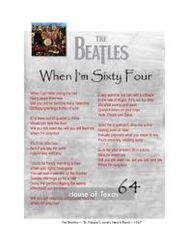
In 2007, Paul McCartney told an interviewer that the Beatles song When I’m Sixty-Four had been on his mind. “Heard it a lot recently – I wonder why?” he said, with a laugh.
Everyone knew the answer: The ex-Beatle had turned 64. And so did I, recently. The song has been on my mind, too. In fact, I can’t stop thinking about it. I sing it in the shower, whistle it as I walk to work, and hum it on my way home. I even played it for my students in class.
They weren’t impressed. The song is about old age, which is something that young people usually don’t think about. And why should they, really? When I’m Sixty-Four reminds us about how much we get wrong when we imagine aging. It’s probably good to put it out of our minds, as best we can.
Mr. McCartney composed the song’s tune on his father’s piano when he was a teenager. His father, Jim McCartney, was a jazz trumpeter who took Paul to big-band shows. The melody has a jaunty cabaret sound. But Mr. McCartney didn’t add words to it until much later, around the time his dad turned 64; it was recorded in 1967 for Sgt. Pepper’s Lonely Hearts Club Band. Mr. McCartney was only 24. And nothing in the song resembled what the family had experienced.
Put simply, When I’m Sixty-Four is a tribute to a kind of domestic tranquility that eluded the McCartneys. The narrator imagines himself fixing things around the house while his wife knits a sweater by the fireside.
The couple is solidly – and humbly – middle-class. The song tells us they will “scrimp and save” to afford a cottage on the Isle of Wight, a common British holiday spot, where they will bounce grandchildren on their knees.
That wasn’t how things went down in the McCartney home. Mr. McCartney’s mother died after an operation for breast cancer when he was 14. A midwife, she was the family’s primary breadwinner. When Mr. McCartney heard the news, his first reaction was to ask how the family would survive without her income.
By the time he penned the words for When I’m Sixty-Four, Mr. McCartney was on his way to becoming one of the wealthiest musicians in the world. The song was a “parody” of aging, as the New Yorker critic Lillian Ross wrote. And, more to the point, it envisioned a family that Mr. McCartney didn’t have.
But he wanted one. After a failed engagement and multiple love affairs, Mr. McCartney wed the American photographer Linda Eastman in 1969. They had kids, settled on a farm and created the kind of family described in When I’m Sixty-Four.
Tragically, Linda died in 1998 of the same disease that had felled Mr. McCartney’s mother: breast cancer. He married again, to Heather Mills, but that union soon dissolved amid allegations that he had pushed Ms. Mills into the bathtub during a fight and cut her arm with a broken wineglass. (Mr. McCartney said at the time he would “vigorously” defend himself against the claims.)
Mr. McCartney separated from Ms. Mills in May, 2006. A month after that, he turned – you guessed it – 64.
That doesn’t seem as old now as it did then. When Mr. McCartney was born, in 1942, the average life expectancy for an infant boy in Britain was 63 years. The protagonists in his song were already a year older than that.
Today, as Mr. McCartney recently quipped, 64 “looks quite sprightly.” And few of us look as sprightly as Sir Paul, who continues to tour at the age of 83. But much of his life diverged from the script he imagined, because nobody can write their own story. Not even Paul McCartney.
I’ve been fortunate in ways that he wasn’t. I’ve been married to the same lovely woman for almost four decades. Like Linda McCartney, she had breast cancer. But my wife survived. We were blessed with two brilliant and beautiful daughters. And next spring, we will welcome our first grandchild.
I want to be like the old guy in the song, bouncing my grandkid on my knee. I also know that a lot of this stuff is outside of my control. I’ve got it good, for now. But anything can happen as we age.
So, I’m not going to think about it. I’ll try to live each day as it comes, and to love the people around me. And if I’m lucky, I’ll be singing When I’m Sixty-Four for a good long time.
Source: Jonathan Zimmerman/theglobeandmail.com