- Register
- Log in to Tune-In
- Wishlist (0)
-
Shopping cart
(0)
You have no items in your shopping cart.

Jeff Lynne reveals the truth about George Harrison after the Beatles
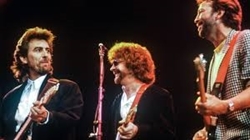
George Harrison didn’t need the Beatles to prove himself. But according to his closest collaborators, he still needed a band.
In the aftermath of the group’s breakup, Harrison appeared to adapt to solo life more naturally than any of his former bandmates. He was the first to release a solo album, 1968’s Wonderwall Music, and when the group finally dissolved, he surged creatively. His 1970 triple album, All Things Must Pass, was both a commercial triumph and a personal vindication, proving that the guitarist long overshadowed by Lennon and McCartney had a world-class voice of his own.
Yet even at the height of that success, Harrison never fully embraced being a solo artist.
Instead, fate — and friendship — would pull him back into a band setting, alongside Bob Dylan, Tom Petty, Roy Orbison and Jeff Lynne in the Traveling Wilburys. Speaking to Uncut in 2007, Harrison’s widow Olivia said the supergroup restored something he’d been missing since the Beatles’ collapse.
Every night, as we were relaxing with a few drinks, George and I had the same conversation: ‘We could have a group, you know?’ ‘Yeah, we could.’”
— Jeff Lynne
“George had those intense moments in his career when it was absolute bedlam,” she said (via Guitar.com), referring to periods including his turbulent final years in the Beatles and his personal upheaval involving Eric Clapton. “So there were times when he craved solitude, but he also loved being with friends.”
Lynne saw that conflict firsthand while producing Harrison’s 1987 comeback album, Cloud Nine. All the latest guitar news, interviews, lessons, reviews, deals and more, direct to your inbox!
“We were three-quarters of the way through Cloud Nine, and every night, as we were relaxing with a few drinks after mixing a big epic or whatever, George and I had the same conversation,” Lynne recalled. “‘We could have a group, you know?’ ‘Yeah, we could.’
“He didn’t like the idea of being a solo guy — that’s what he told me. He was never comfortable with it. He wanted a group, and, of course, George could do anything he wanted.”
Harrison’s explosive burst of creativity in 1970 suddenly makes more sense in that light. All Things Must Pass wasn’t just artistic release — it was backlog, as years of suppressed songs were finally given oxygen. But as the decades passed, his output slowed. He released six albums in the 1970s, but only three in the 1980s. Cloud Nine was his first in five years.
Source: guitarplayer.com/Phil Weller