- Register
- Log in to Tune-In
- Wishlist (0)
-
Shopping cart
(0)
You have no items in your shopping cart.

Beatles News
In mid-1971, more than a year after the Beatles officially split, John Lennon started recording what would become his second proper solo album, Imagine.
The album, which was released later that year, was a critical and commercial success, not to mention a perennial fan favorite.
It also marks one of the only times Lennon recorded with his former Beatles bandmate, guitarist George Harrison, after the dissolution of the Fab Four in 1970. Harrison's fretwork can be heard on several Imagine tracks, including "I Don't Wanna Be a Soldier," "Gimme Some Truth" and "Oh My Love." He even plays a mean dobro on "Crippled Inside."
However, from a six-string perspective, there's just something special, and maybe a bit chilling, about Harrison's slide work on "How Do You Sleep?," which also happens to be the most "anti-Paul McCartney" song ever written. In fact, it's downright mean. Lennon was getting back at McCartney for what he perceived were some anti-John-and-Yoko lyrics on McCartney's Ram album, which was released earlier that year. Here are some choice lyrics from Lennon's "How Do You Sleep?," plus some commentary from yours truly:
By: Damian Fanelli
Source: Guitar World
The music of the Beatles, four music geeks from Liverpool who made it rather big in the Sixties, will appear on music streaming sites like Spotify, Tidal and Apple Music for the first time on Christmas Eve. This comes five years after Apple Music and Apple Computer ended a decades-long rights dispute, the upshot of which was the Beatles' official output becoming available on iTunes.
The Beatles are big, like no other band has ever been big, or can ever be. The Cambridge Companion to the Beatles pinned down their singularity by noting that there's no serious body of academic literature about the Dave Clark Five. The Beatles are the yardstick to which other bands are compared, usually in terms of record sales, seldom in terms of cultural significance. The Beatles' very popularity has been used as a stick to beat them with: no band that popular can be good, so the 'argument' goes, because everybody knows, don't they, that the best music is the most original music, and original music is always unpopular (because people are idiots, or something). This particular chain of reasoning forces some unwelcome conclusions: for example, that JS Bach is the most overrated composer in musical history, and also that all traditional musi details
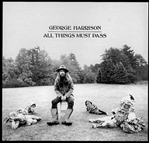
Classic album is a term that’s used way too much when describing records from the golden era of rock music; of course, one person’s classic album is another’s long-forgotten record, but we think that without fear of contradiction George Harrison’s All Things Must Pass is a CLASSIC album… 45 Years ago, on 19 December it made the Billboard album charts on 19 December 1970 and two weeks later it was No.1.
There’s an old adage in the music business that talks of, ‘the difficult third album’, well this was George’s third solo album and there’s nothing difficult about it, every track is worthy of its place, there’s no filler, just killers… and it was originally released as a triple album when it came out on 27 November 1970. Ben Gerson of Rolling Stone described the sound as "Wagnerian, Brucknerian, the music of mountain tops and vast horizons," and who are we to disagree? Truth is George considered this to be his first solo album proper, having originally released his movie soundtrack, Wonderwall Music and his synthesizer album, Electronic Sound.
The genesis of All Things Must Pass can be said to have begun with George’s visit to America details

He's graced the biggest stages in the world. But Paul McCartney still looks as excited as any regular punter at a hockey game to have his face emblazoned on the big screens. The 73-year-old Beatle cheered as his image was broadcast at the Washington Capitals vs New York Rangers hockey game at Madison Square Garden on Sunday.
He joined in with the crowd, alongside two of his children - son James, 38, and daughter Mary, 46. Clad in a black blazer and sweater, the music legend looked younger than his years. Photographer Mary was ever on duty - capturing the moment with a snap on her 'phone - as she wore a navy sweater adorned with birds.
She showed the image to the delighted Hey Jude singer. Her youngest son, four-year-old Sid Aboud looked rather bemused by all the fuss as he sat on his mum's knee next to his famous grandfather. Sid - whose father is Mary's director husband Simon Aboud, lives in England with his parents but looked every inch the all-American fan in blue and red team colours, a baseball hat and a giant foam finger.
Musician James, who shares his father's distinctive cherubic looks, wrapped a check scarf around his neck as the siblings joined Paul for the holiday season on NYC, where he details
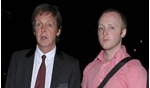
Choosing to follow Sir Paul McCartney into the music business has not been an easy path for his son James, who is struggling to emulate the success enjoyed by the former Beatle.
Last week James, 38, was met with a mediocre response from customers when he sang and played guitar at a small pub, The Islington, in North London. Only a handful of the audience remained to see the end of his performance and there were certainly no calls for an encore. A blonder, less confident version of Paul, James has found it hard to make his own name in the music business; he finds playing live on stage difficult because of his shyness, and friends say he is constantly aware of living in his father’s shadow.
While his sisters, Stella and Mary, have prospered from their father’s fame, Sir Paul’s only son often refused to tell new friends his surname when he worked as a waiter in Brighton. Like the rest of the family, he is a strict vegan, but has had issues in the past with his weight. James was 19 and an art student when his mother Linda was diagnosed with breast cancer.
He found therapy in playing the guitar and, a month before Linda’s death in 1998, he recorded a track with her, The Light Comes Fro details

Paul McCartney joined Bruce Springsteen for a surprise performance on Saturday Night Live last night (December 19). McCartney joined Springsteen and the rest of the sketch show's cast, including hosts Tina Fey and Amy Poehler, on a cover of 'Santa Claus Is Coming To Town'. Earlier in the night Springsteen & The E Street Band performed two songs from the recently released 'The Ties That Bind: The River Collection' box set, 'Meet Me In The City' and 'The Ties That Bind'.
Springsteen recently unveiled plans to mark 1980 album 'The River' during his upcoming 2016 tour. A reissue of the album was released on December 4. The River Tour will see Springsteen touring North America from January to March, kicking things off in Pittsburgh on January 16 and finishing up with two shows in Los Angeles from March 15-17. Springsteen is likely to play 'The River' in full and draw heavily from its recent box set release during the tour. 'The Ties That Bind: The River Collection' features the original album plus unreleased music, unseen concert footage and a new documentary.
The double-album gave Springsteen his first US Number One Record and resulted in an extensive touring period. The third disc presents Springsteen's show wi details
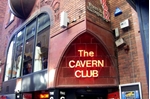
The brother of Liverpool musician Holly Johnson is calling for the Cavern Club directors to be awarded a Freedom of the City honour.
James Johnson, the brother of Frankie Goes to Hollywood frontman Holly, believes the directors, particularly Dave Jones and Bill Heckle, should be recognised for their contribution to Liverpool’s music scene.
Mr Johnson, 51, said: “They were the people who started the business off in 1983. They had a vision in them days and they have more than achieved what they set out to do.”
The two men currently run The Cavern pub and club, both on Mathew Street, and also the city’s official Beatles Magical Mystery Tour. They have also run the Mathew Street festival, now known as the International Beatle Festival, for the past 20 years. Most recently, the Cavern Club directors donated four bronze statues of the Beatles to Liverpool.
The Fab Four, sculpted by artist Andrew Edwards, were unveiled on Pier Head last week. Mr Johnson, who works as a freelance Beatle guide, said: “What they have done for Liverpool and it’s tourism industry is really second to none. They have bought millions of visitors to the city and they attract business from all details
First, a little story:my 11-year-old daughter recently gained a merit mark at school for bringing in a book of Beatles lyrics and discussing them.
"Well done," I said. "And what was the lesson you were in? English? Music?" "No, Dad," she replied, "History...."
Well, indeed. It's getting on for half a century since the Beatles were at their peak, so I guess that does count as history. Even so, it's certainly living history, as a packed Colston Hall turning out for the Fab Four can attest.
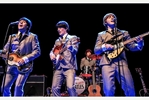
Of course, it's not them. How could it be? But if you want as near-as-dammit, the Bootleg Beatles have been filling that gap for ages now – the original, and beyond doubt, the best.
More than 50 years since John, Paul, Ringo and George last stepped on the Colston Hall stage in their expensive winklepickers, tonight it's the turn of Adam, Steve, Hugo and Stephen to do the honours.
They're good. Very good. Using authentic amplifiers, drums and guitars, plus an orchestra, the Fake Four breeze through a selection of hits, occasional album tracks and costume changes representing that short but world-shaking era in popular music. The hall's legendarily patchy sound quality only adds to the lo-fi appeal, a details
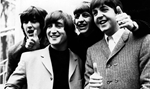
A "happy crimble" from the mop tops.
The Beatles, the most beloved rock band in history -- and one of the most persistent holdouts in the digital age of music listening -- are set to finally arrive on streaming services, according to Billboard sources with knowledge of the negotiations.
While Billboard has received conflicting reports on the timing of the Fab Four's arrival to streaming platforms, there's a strong indication that fans will be able to hear "Hey Jude" on Thursday, Dec. 24. (Keep an eye out for whether Liverpool's most famous sons unseat Justin Bieber's streaming record.)
Chatter around a six month "exclusive" for a known streaming service reportedly began to trickle out of Apple Records in 2014, according to one source, but fizzled out. This past January, former Universal Music Group digital executive Rob Wells restarted discussions for the massive get, with papers reportedly having been signed in mid-September. It's unknown which specific services have secured the deal, though sources strongly suggest that most, if not all, will have access to the band's catalog of studio albums next week. (The Beatles are already available on Pandora because of how "non-demand" web radio is licensed.)
details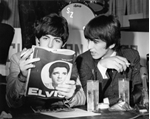
Rock music began in the 1950s as a fusion of country and R&B, but the influential and initially controversial genre proved its longevity as it spanned across multiple decades. Even today, as it’s often eclipsed by hip-hop and electro-tinged pop music in the Billboard charts, rock endures in the DNA of popular songcraft and in the hard-edged production and instrumentation of many underground and alternative acts. The long history of rock music, encompassing literally hundreds of movements and subgenres, is impossible to condense into something easily digestible, but we tried anyway, using specific artists to summarize the origins and the impact of several key eras and movements within rock music.
1. Elvis Presley
Rock and roll music became a significant cultural force in the mid-1950s, as multiple artists culminated showy, energetic public images while releasing hit singles bridging the genres of rockabilly, country-western music, R&B and of course, rock music. The biggest star of this formative period for rock and roll music was the Memphis-based singer Elvis Presley, whose 1954 single “That’s All Right (Mama)” is often placed in the running for the first bona fide rock song. Skew details
Paul McCartney stars in the new video for "Love Song to the Earth," an all-star collaboration recorded in the lead-up to the Paris climate conferences. While the lyric video was unveiled in September, McCartney, along with Colbie Caillat, Sean Paul, Natasha Bedingfield and Q'orianka Kilcher, appear in the song's proper video exploring the beauty of the planet and the potential ravages of climate change. The video follows an accord that aims to cut greenhouse gas emissions.
In the Trey Fanjoy-directed video, which premiered earlier this month at the COP21 conference in front of UN Secretary-General Ban Ki-moon and other world leaders, McCartney sings his verses while strolling alone on the beach and gazing out toward the ocean. Award-winning cinematographer Louis Schwartzberg contributes the stunning images of nature in the video.
"I'm glad to be a part of 'Love Song to the Earth,' aiming to inspire people across the world to urge their leaders to act on climate change," McCartney said in a statement prior to the Paris climate talks. "We need to be fast and efficient, switching to renewable energy and eating less meat, for example. Big decisions will be made this week, so I am doing everything I can t details
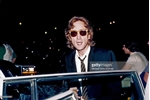
John Lennon came to New York City in the wake of Beatlemania and found refuge in the City That Doesn’t Care How Famous You Are. He quickly discovered that he could wander the streets, go to movies, and eat at restaurants without being bothered. He developed that specific city loyalty that’s unique to transplants, the gratitude that’s born out of the relief at finding the place you belong, and having that place embrace you wholeheartedly.
When John and Yoko arrived in 1971, they moved into the 17th floor of the St. Regis Hotel, but shortly abandoned their uptown luxury abode for a two-bedroom loft apartment in the West Village. 105 Bank Street soon became a locus of activity, both political and musical, with visitors from all along the spectrum coming at all hours of the day and night — including, of course, the FBI, who were investigating Lennon’s radicalism as grounds for deportation. John and Yoko had immediately gotten involved in a host of social causes, from the Vietnam War, to John Sinclair’s arrest for possession, to the Attica Prison riots. They hung out with the Yippies and the Black Panthers, and commemorated much of their life in the song “New York City” on Lenn details
A little over a decade ago, Mario Cantone performed a one-man show on Broadway in which he reminisced, among other things, about his first acting gig in New York City when he was cast as a rustic in a Shakespearean comedy performing in Central Park. Night after night, the audience never laughed, and he wanted to scream out at them, “You try to making f-king 400-year-old jokes work!”
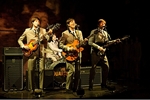
I thought of Cantone’s comment while I watched the new musical “These Paper Bullets!,” which opened Tuesday at the Atlantic Theater Company’s Linda Gross Theater. It’s based on the Bard’s “Much Ado About Nothing,” and it makes you wonder why anyone would rework an f-king old plot about lovers who are deceived into thinking they’ve been unfaithful.
Rolin Jones has updated the story to 1964 and set it in London during the heyday of the Beatles, Mary Quant and Vidal Sassoon, although only the hairdresser is a character (very minor) here. Jones’ Fab Four is a group named the Quartos, which hires a talented drummer (James Barry) after dropping an untalented one (Adam O’Byrne), who vows revenge and so kick-starts the story, which is impossible to follow if you do details
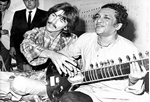
About the transient nature of human existence, legendary sitar virtuoso Ravi Shankar influenced George Harrison’s post-Beatles song, All Things Must Pass. Timothy Leary’s psychedelic adaptation of the Tao Te Ching, Harrison’s love for Eastern music and philosophy was ignited by Shankar’s tutorial of the Indian instrument with distinctive timbre and resonance that included learning the music’s philosophy.
At 92, Shankar has completed his cycle of life at a San Diego medical facility.
Last year, he was treated for upper respiratory and heart ailments. The heart-valve replacement surgery he underwent recently failed to extend his life. Wife Sukanya and daughter Anoushka, also a sitar virtuoso, were by his bedside. Jazz singer Norah Jones is also his daughter by concert producer Sue Jones.
Neil Portnow, president of the National Academy of Recording Arts & Sciences, had informed Shankar before he died that Shankar would receive Grammy Award for a lifetime achievement in February.
Shankar’s immeasurable influence on classical and contemporary music led the Beatles to their multi-cultural phase that became the benchmark of their maturity period that produced the details
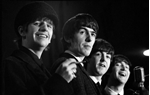
Washington disc jockey Carroll James didn't realize it at the time, but on this day, in 1963, he helped The Beatles launch the third British invasion of America. This time, the attack didn't come by land or by sea, however...this one was by air. More precisely, the air waves. The first shot fired in the assault on every facet of American culture came in the form of a song, "I Wanna Hold Your Hand," by The Beatles. By the time this invasion was done, our musical and cultural landscape would never be the same.
The Beatles, who served as the vanguard for this sonic assault on our shores were already conquerors at home. After a few years honing their skills, John Lennon, Paul McCartney, George Harrison and Ringo Starr had seen their fame grow exponentially in late 1962 with their first hit, "Love Me Do." The were dubbed "The Fab Four" and the first stirrings of the soon to be worldwide phenomenon known as "Beatlemania" were felt.
On a snowy, early December day, America's most trusted voice Walter Cronkite was looking for an upbeat story to fill out his show and decided to rerun a recent piece on the Beatles surging popularity in England. The segment had only aired during the morning news, but hadn't been reran as pa details