- Register
- Log in to Tune-In
- Wishlist (0)
-
Shopping cart
(0)
You have no items in your shopping cart.

Remember When Paul McCartney Left George Martin Out of the Loop on a 'Sgt. Pepper
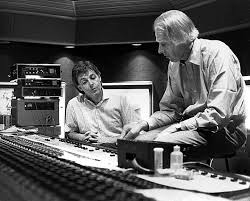
The Beatles likely would have been extremely successful no matter who was producing their records. But there’s no doubt that George Martin, who got the producing gig, helped them elevate their music to heights they might not have otherwise have reached.
Martin’s stewardship while the band made Sgt. Pepper’s Lonely Hearts Club Band was essential. But he was passed over by Paul McCartney for a role he normally would have filled on one of the album’s standout songs. And that turn of events caused hard feelings between the two men. Who Has the Score?
When it came to making Sgt. Pepper’s in 1967, The Beatles wanted every possibility on the table in terms of how the songs would be rendered. Having ceased touring, they had nothing but studio time ahead of them. And they could take as much time as possible to make the sounds in their heads come to life.
True-life events inspired “She’s Leaving Home”. Paul McCartney picked up the newspaper one morning and saw an item about a teenage runaway. With John Lennon assisting, he wrote the song by imagining the inner lives of the girl and her parents and how this happy family had reached this point.
McCartney envisioned the song almost unspooling almost like a television drama. As such, he knew that he didn’t want traditional rock instrumentation. Instead of playing on the song, The Beatles would hand the instrumentation over to hired string players. But a dispute between McCartney and Martin interrupted the band’s usual chain of command.
On previous occasions when The Beatles had used orchestral instrumentation, a la “Yesterday” and “Eleanor Rigby”, George Martin had written the scores that the instrumentalists used to play their parts. McCartney didn’t have the technical know-how to pull off such a feat, although he’d still be involved in telling Martin what he preferred out of each part.
When he decided he wanted that kind of backing on “She’s Leaving Home”, he called Martin to see if he could come to Paul’s house the next day and work up the score. But Martin already had a previous engagement to produce a session for British singer Cilla Black. McCartney pressed Martin for a bit to see if he could make it work before hanging up.
Martin assumed that McCartney would just postpone the score-writing session for a day or two until George could do it. But Maccca’s simply couldn’t wait. He found another arranger named Mike Leander, who came in and wrote the lovely instrumental score for violins, violas, double bass, cellos, and harp that would adorn the song.
Source: americansongwriter.com/Jim Beviglia