- Register
- Log in to Tune-In
- Wishlist (0)
-
Shopping cart
(0)
You have no items in your shopping cart.

The 5 Greatest Beatles Songs Written by John Lennon
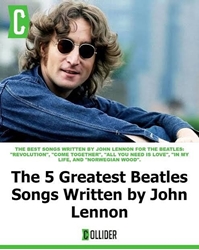
While he is most celebrated as one half of the greatest songwriting duo known to man, John Lennon’s talent as an independent lyricist is just as impressive – even before the dissolution of The Beatles. Throughout his life, he wrote prolifically. Not just songs, but poetry and prose and political essays. He existed in a constant state of creation.
John Lennon and Paul McCartney smiling Image via Instagram/@paulmccartney
5 “Revolution” (1968)
The Beatles made three versions of “Revolution”: the fast-paced, hard rock single version was first released in August 1968. The slower, bluesy version is titled “Revolution 1” and an abstract, artistic iteration called “Revolution 9” appear on The Beatles’ self-titled album, more commonly known as “The White Album.” The single version is by far the best known and the most fitting for commercial reception and radio play.
4 “Come Together” (1969)
“Come Together” is the opening track on Abbey Road, one of their most popular records. It reached number one on the Billboard Hot 100 after the album’s release in 1969. The song was inspired by nonviolent protest of the Vietnam War led by Lennon and his second wife, Yoko Ono. These protests were joined and supported by many of the big players in the counterculture movement, including many new wave politicians. One of these politicians had a campaign slogan: "Come Together – Join the Party!” The phrase stuck with Lennon, and from it, he distilled this song’s title.
3 “All You Need is Love” (1967)
“All You Need is Love” was released as a non-album single in 1967. The song was the United Kingdom’s contribution to Our World – a historic television program, the first live, multinational, multi-satellite broadcast. Artists from all over the world contributed to the program, which was available in 24 countries, but The Beatles’ performance was by far the most highly anticipated.
2 “In My Life” (1965)
Lennon thought of “In My Life” as his first “real” piece of work – despite writing and recording it halfway through The Beatles’ career. The song (and Rubber Soul, the album on which it appears) marks a departure from the more simplistic love songs the band had been producing. It was written autobiographically, based on nostalgia for his childhood in Liverpool. He wrote the lyrics in the form of a poem, initially naming specific places from his childhood before deciding on a more generalized format.
Source: Audrey Connelly/collider.com