- Register
- Log in to Tune-In
- Wishlist (0)
-
Shopping cart
(0)
You have no items in your shopping cart.

Today in History, December 30: Beatle George Harrison stabbed at home
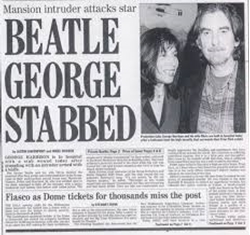
It was a moment of horrible deja vu for music fans around the world — a mentally unwell man had attacked one of the Beatles, leaving him for dead.
It's a headline that could have been from December 8, 1980, but it was also sadly true of this day, December 30, 1999, when George Harrison was stabbed in his home.
Unlike his former bandmate John Lennon, Harrison survived the attack by a knife-wielding attacker, though Harrison's friends and family speculated it ultimately hastened his death from lung cancer less than two years later.
But like the fatal attack on Lennon outside the Dakota Building in New York, the stabbing of Harrison was another case of someone with mental health issues slipping through the cracks and not getting the help they needed before doing something horrible to a much-loved musician.
A troubled man struggling
About a month before he broke into Harrison's home and stabbed the former Beatle, Michael Abram was in a psychiatric ward in Merseyside, the English county centred around Liverpool.
The 33-year-old father of two had been grappling with addiction and undiagnosed schizophrenia for the previous decade, according to reporting from the BBC and The Guardian at the time and police had taken him to a Merseyside hospital in November 1999.
Abram's mother Lydia told the BBC the health system had failed her son and was "totally and completely useless".
After leaving hospital, Abram returned to the 10th floor flat where he lived alone in Liverpool, sitting "on an up-turned plant pot" in his "sparsely-furnished rooms", listening to The Beatles, John Lennon, U2 and Bob Marley, a court later heard.
His neighbours watched him walk to the chemist each week to collect his methadone, singing Beatles songs as he went.
All the while, Abram was sinking further and further into his delusions.
The hearings held in the wake of Harrison's stabbing heard Abram had witnessed a total eclipse on August 11, 1999, which led him to believe he was St Michael and on a mission from God to kill Harrison, who Abram believed to be the "phantom menace" that was possessing him.
"He thought George Harrison was the alien from hell," psychiatrist Phillip Joseph told the court.
"He thought the Beatles were witches flying on broomsticks from hell."
a policeman walks past an ornate gate
A policeman stands guard outside Harrison's home after the stabbing. (Reuters)
The attack
Harrison lived at Friar Park, a Victorian mansion built in 1889 that he'd purchased in 1970, at Henley-on-Thames, west of London, some 300 kilometres south-east of Abram's Liverpool home.
On December 29, Abram arrived at a nearby local church and asked the vicar: "Where does the squire live?"
It wasn't the first time Abram had travelled from Liverpool to Henley-on-Thames and asked about Harrison.
But this time, things were different. He had with him a metre-long cord and a knife. Abram loitered around the property, and sang in the nearby town square, apparently "hoping to provoke an uprising against the star", Morris wrote.
At about 3:30am, Abram scaled the walls around Friar Park, evaded security, and used part of a statue George Harrison's wife, Olivia, had made to break a window and gain entry to the mansion.
Olivia heard the noise and woke her husband, who went in search of the sound, pulling on a jacket and a pair of boots over his pyjamas.
According to detailed court reporting at the time for The Guardian, Olivia rang staff and police as Harrison spotted Abrams in the main hall.
Abrams began screaming up at Harrison, who was above him on the landing, and in an attempt to distract the attacker, Harrison began shouting "Hare Krishna, Hare Krishna" back at him.
The intruder advanced up the stairs and Harrison, thinking about his wife, son and mother-in-law in the house, lunged at Abrams, trying to grab the knife from him.
"We fell to the floor," Harrison told the court. "I was fending off blows with my hands. He was on top of me and stabbing down at my upper body." Olivia arrived and attacked Abrams with a small brass poker, causing Abrams to attack her too.
"There was blood on the walls and on the carpet," she told the court.
Source: Matt Neal/abc.net.au