- Register
- Log in to Tune-In
- Wishlist (0)
-
Shopping cart
(0)
You have no items in your shopping cart.

Beatles News
Many artists rose to the occasion with tributes to John Lennon in the immediate aftermath of his death. You could make the argument that it took those that were closest to him and shared in the experience of The Beatles to do it best. Paul McCartney’s “Here Today” tried to imagine how Lennon would react to such a tribute. And George Harrison’s “All Those Years Ago” reflected Lennon’s unique standing in the culture as a polarizing figure, while also reconciling Harrison’s own feelings about his departed friend.
What went into Harrison creating the song? How did it evolve based on Lennon’s death? And what made it a kind of Beatles reunion record? Let’s go back to how it got started with, oddly enough, a rejection.
Many of Ringo Starr’s greatest solo successes came courtesy of, you guessed it, a little help from his friends. Specifically, Harrison had a hand in writing two of Starr’s biggest singles: “It Don’t Come Easy” and “Photograph.” Harrison intended the same thing with a song he wrote entitled “All Those Years Ago.” He thought it fit his old bandmate, and Starr recorded the song with the help of details
When The Beatles broke up, John Lennon, Paul McCartney, George Harrison, and Ringo Starr, were on decidedly bad terms. They were embroiled in a legal battle and spoke publicly about their gripes with one another. One of Lennon’s biggest problems with his bandmates was how unwelcoming they were to Yoko Ono. While it angered him, he still said he could understand their frustration.
John Lennon understood why his Beatles bandmates were unhappy with him
Lennon and Ono were incredibly close, both emotionally and physically. She joined him in the studio, to the irritation of the other Beatles.
“He just wanted to go off in the corner and look into Yoko’s eyes for hours, saying to each other, ‘It’s going to be all right,’” McCartney said in The Beatles Anthology. “It was pretty freaky when we were trying to make a track.”
Source: imdb.com
details
Do you prefer the Beatles to Wings? Yeah, duh — even Paul McCartney knows that his first big band far outstripped his second, as he has now admitted.
In an episode of the podcast McCartney: A Life in Lyrics on iHeartPodcasts, McCartney discussed "Band on the Run," the title track of Wings' third album. He acknowledged that, even before Wings began, he knew they would never be able to equal the magic of the Beatles.
"A lot of this is just happening in my own mind. It's not what anyone's telling me," he reflected. "I'm automatically thinking, 'Well, the Beatles were great, so Wings is not going to be as great.' My problem all along was: after the Beatles, who's gonna be as good as them? I kind of knew it couldn't happen."
Taking a slightly more optimistic outlook, McCartney continued, "I thought, 'Yeah, but we can be not as the Beatles, but we can be something else."
He acknowledged that it was difficult to know he could never match the heights of the Beatles, but said that he still had "reserves of courage" from the days when the Beatles toughed it out as an unknown band.
Even if Wings never reached the fame or acclaim of the Beatles, they did find success of their own. McCartn details
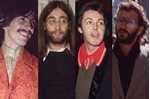
After The Beatles broke up, each member faced the colossal task of making music under the shadow of the biggest band in history. Paul McCartney took a lot of heat and his early solo albums were not well received by critics. Looking back, the McCartney I and McCartney II home recordings are pretty special.
John Lennon wanted peace and George Harrison wanted a different kind of peace. The quiet kind. Ringo Starr is beloved but he won’t break this Top 10 list.
After The Beatles, the dismantled parts of the greater sum had to learn to create on their own.
“Handle with Care” could have been a solo George Harrison song. Instead, the session featuring Jeff Lynne, Tom Petty, Bob Dylan, and Roy Orbison resulted in a new band, Traveling Wilburys. Otherwise, “Handle with Care” is most definitely on this list. “Got My Mind Set on You” almost made the cut. Alas, it’s a cover.
The Beatles were a supergroup formed in reverse. Here are the top 10 solo songs by a Beatle.
10. “Jenny Wren” by Paul McCartney (2005)
Source: Thom Donovan/americansongwriter.com
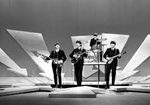
It’s been 60 years since photographer Harry Benson reluctantly agreed to cover the Beatles, first in Paris and then on their historic visit to the United States.
Now 94-year-old Benson reflects on the close relationships he developed with John Lennon, Paul McCartney, George Harrison and Ringo Starr.
They allowed Benson to capture some iconic moments from their pillow fight the night “I Want to Hold Your Hand” hit the top of the American charts, to their historic appearance on the Ed Sullivan Show.
Benson decided to stay in the United States where his subjects included former presidents Dwight Eisenhower, John F. Kennedy, Richard Nixon and Bill Clinton, in addition to American icons like Muhammed Ali, Jackie Kennedy and Michael Jackson. As a photojournalist, he chronicled Robert Kennedy’s last moments and walked alongside Martin Luther King, Jr. at the Meredith march.
He joins host Robin Young to talk about his years with the Beatles and how photography shaped his life. An exhibition celebrating the 60th anniversary of his arrival in the U.S. with the Beatles runs through February at New York’s Museum of Art and Design.
Source: wbur.org
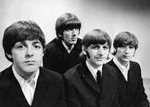
So much is known about The Beatles, as interest in the band has remained incredibly high for decades, ever since they took over the world in the mid-’60s. Countless fans, journalists, documentarians, and historians have attempted to answer every question related to the musicians, but one big query remains: how did they get their name? It seems like a simple ask, but it’s one that no one can answer definitively – not even one of the members of the group.
In the latest episode of his iHeartRadio and Pushkin podcast Paul McCartney: A Life in Lyrics, the Beatles singer, songwriter, and musician opened up about the band’s name and how it came to be–though he couldn’t share any definitive answers. “The actual origin of it is clouded in mystery,” McCartney confirmed, essentially admitting that even he doesn’t remember.
While he can’t confirm or deny any of the possibilities that have been presented throughout the years, McCartney did share what he remembers of that time. “My memory of it was that we went striving to find something with a dual meaning,” the famous musician commented during a discussion of the forming of the group. He also said that details
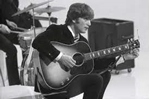
John Lennon wrote a book after he joined The Beatles. He admitted that he could have been an author if he didn't pursue music.
In 1964, John Lennon extricated his public image from The Beatles when he published the book In His Own Write. The book, which was full of Lennon’s nonsensical poems and short stories, received acclaim from critics. It proved that even if he hadn’t been a famous musician, he may have been able to find success as a writer.
Lennon became a published author in 1964. It wasn’t necessarily something he sought out to do; he had simply amassed enough writing to fill a book.
“It’s about nothing. If you like it, you like it; if you don’t, you don’t. That’s all there is to it,” Lennon said of In His Own Write in The Beatles Anthology. “There’s nothing deep in it, it’s just meant to be funny. I put things down on sheets of paper and stuff them in my pocket. When I have enough, I have a book.”
He didn’t think he ever could have become a published author without The Beatles. Still, he knew he would have been a writer regardless of his level of fame. He wondered if he could have been a Beat poet.
< details
John Lennon said The Beatles had to change in order to become famous. He shared why they felt this was necessary.
After The Beatles broke up, John Lennon had no fear of speaking his mind. He gave lengthy interviews in which he spoke poorly about his bandmates and their music. While Lennon spoke his mind in The Beatles — he notably caused a stir when he said The Beatles were bigger than Jesus — he said he wasn’t as honest as he wanted to be. He shared why they had to compromise in order to achieve success.
In the early years of The Beatles, the band received criticism for their clothing and long hair. According to Lennon, their style was already a compromise. They had to change themselves in order to seem palatable to the public.
“We weren’t as open and as truthful when we didn’t have the power to be,” Lennon said in The Beatles Anthology. “We had to take it easy. We had to shorten our hair to leave Liverpool. We had to wear suits to get on TV. We had to compromise.”
He said they didn’t necessarily realize they weren’t being truthful. They were just doing what it took to get their music career off the ground.
“We had t details
Paul McCartney is far and away one of the most successful musicians of all time in his home country of the U.K. In fact, depending on how one measures that title, he may win, as he has been racking up sales and hits since he launched his musical career more than half a century ago.
This week, McCartney is back on the U.K. albums chart, but not with a brand new title. Instead, he returns with one of his most beloved projects–which has now reached the ranking of the top-consumed albums in the country in four separate instances.
McCartney appears at No. 16 on the U.K. albums chart with Band on the Run. The third full-length from the former Beatles’ new band Wings was recently reissued for its fiftieth anniversary. The Official Charts Company counts the new extended edition as a separate entity, and its immediate success adds to the legend’s career totals.
According to the Official Charts Company, Band on the Run has now reached the albums chart in the U.K. four times. The set has spent more than four weeks on the tally–many more frames, actually. The title has now appeared on the ranking in four different forms, which speaks to not only how long the album has been around, but also it details
After the Beatles broke up in 1970, drummer Ringo Starr faced a crossroads. The Beatles’ Let It Be would close the book on that iconic group. It was a transitional time for the famed musician, who had already acted in the movies Candy and The Magic Christian, the latter with Peter Sellers. With his time in the most famous rock band of all time coming to a close, new adventures awaited him. These included an unexpected cinematic character study that begat an incredible sequel.
On the music front, Starr was the first Beatle to release a proper solo album on March 27, 1970 entitled Sentimental Journey. This was even before Let It Be hit stores. It was his take on the Great American Songbook, which he followed with the country collection Beaucoup of Blues on September 27. These two releases sold decently, with his debut going Top 10 in the UK and Top 30 in America. Two non-album singles co-written with his former bandmate George Harrison, “It Don’t Come Easy” and “Back Off Bugaloo,” went Top 5 in the UK and Top 10 in the U.S.
But it was in 1973 that his third album Ringo became a bonafide hit, going Gold in America and eventually Platinum. The two singles “Photograph” details
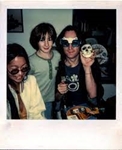
Get ready to see John Lennon like you’ve never seen him before.
A pop-up exhibit of candid photographs of the former Beatle, taken during his 18-month “Lost Weekend" from late 1973 to early 1975, is coming to the Keshet Gallery in Boca Raton the weekend of Feb. 16.
And the photographer who took them will be there, too.
“The Lost Weekend – the Photography of May Pang” showcases 31 images that cast a vastly different light on a period of Lennon’s life known mainly in rock lore for its overindulgence and excess partying.
Look at Pang’s photographs, and it’s clear the “Lost Weekend” was also about family, friends, love and reconnections.
The intimate glimpse is made possible because Pang was not just traveling in his circle, she was also his lover — one he took at the urging of, and while on hiatus from, his wife, Yoko Ono.
Love may be complicated, but the images collected are not.
There’s Lennon and his son Julian opening Christmas presents on Palm Beach in 1974 (five years before he bought El Solano on A1A and became a brief part-time island resident). There’s Lennon at Disney World walking unnotic details
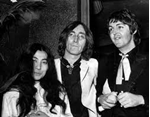
John Lennon began bringing Yoko Ono into the studio with The Beatles. Paul McCartney said some of their behavior was off-putting.
The songwriting relationship between Paul McCartney and John Lennon was one of the most prolific of all time. They began to write on a more individual basis as the 1960s wore on, and their working relationship fell apart entirely when The Beatles broke up. McCartney noticed a shift in their dynamic when Lennon met Yoko Ono. He believed Lennon was intentionally putting distance between them to leave more time for her.
When Lennon and Ono began a relationship, they started spending all their time together. He brought her to Beatles recording sessions, which bothered his bandmates.“Now John had to have Yoko there,” McCartney said in The Beatles Anthology. “I can’t blame him, they were intensely in love — in the first throes of the first passions — but it was fairly off-putting having her sitting on one of the amps. You wanted to say, ‘Excuse me, love — can I turn the volume up?’ We were always wondering how to say, ‘Could you get off my amp?’ without interfering with their relationship.”
Source: Emma Mc details
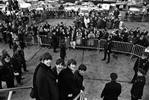
I was not yet 9 and living in Glenwood, Mrs. Thrash dutifully teaching third grade, when the Beatles invaded America. Asked for a world view, I would not be on the cutting edge of events.
That's 60 years ago, the same month that Louisville's Cassius Clay, speaking out when some Black youths in the South were fighting off police dogs, "shook the world" winning the heavyweight boxing championship.
As Muhammad Ali, whose bravery in the ring didn't stop people from calling him a coward when he refused military induction three years later, the Louisville Lip affected Western civilization.
So did the Beatles, four British chaps who brought their act over from Liverpool and shook the world before Clay entered the ring against Sonny Liston.
John, Paul, George and Ringo wore their hair foppishly long for the time. My dad took one look at the Fab Four and called them "hippies." Still, I ran home from church to watch the mop-toppers perform on the "Ed Sullivan Show."
The year 1964 was to them like 1973 in horse racing for Secretariat, 1998 in home runs for Mark McGwire, almost any year in hockey for Wayne Gretzky. Unsurpassed in every respect, although the Bee Gees came close musically in 1978 like details
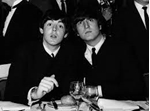
Paul McCartney has misplaced an extremely rare, valuable Beatles artifact, as he lost the notebook where he and John Lennon wrote their earliest songs.
He lost the notebook within the past decade or so. Speaking on the podcast McCartney: A Life in Lyrics (which just launched its second season on iHeartPodcasts), he described how he would skip school to work on music with John Lennon. He would write down their compositions in an exercise book he had taken from school — "a nice little blue book, a hardback," he said.
"The school exercise book, I found it probably about 10, 15 years ago," McCartney explained. "I put it in my bookcase, and I've since lost it. I don't know where it is. I think it might show up somewhere, but it's the first-ever Lennon–McCartney manuscript."
The podcast's host, poet Paul Muldoon, said, "Oh dear." McCartney responded, "'Oh dear' is right, but you have to let these things go."
That book included the early hit “Love Me Do" (which is the subject of the episode of A Life in Lyrics) and "One After 909." It also included unreleased songs like the country number “Just Fun" and the doo-wop-inspired “Too Bad About Sorrows," each of which McCartney s details
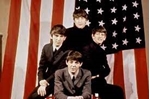
As 4,000 mostly hysterical school-skipping girls lined the Tarmac on their arrival, Paul McCartney, 21; George Harrison, 20; and Lennon and Starr, both 23, were given their first taste of what the US had in store for The Beatles
Moments before touching down at New York's windswept JFK airport, the captain of Pan Am flight 101 told a flight attendant: "You better tell the boys there's a big crowd waiting for them".
But stepping off that Boeing 707 on February 7, 1964, not even the Fab Four could have envisaged just how 'Beatlemania' would go on to grip America. Before taking off from London, John Lennon said to himself "Oh, we won't make it," while drummer Ringo Starr recalled feeling "a bit sick" with anticipation.
But as 4,000 mostly hysterical school-skipping girls lined the Tarmac on their arrival, Paul McCartney, 21; George Harrison, 20; and Lennon and Starr, both 23, were given their first taste of what the US had in store for them. "Pandemonium broke out among the stamping, banner-waving fans as The Beatles - John, Paul, George and Ringo - stepped from the plane," the Mirror wrote on its front page the following day.
Source: Christopher Bucktin/themirror.com